Business · Analysis & Valuation

Financial Ratios Calculator

Short answer: What does the Financial Ratios Calculator calculate?

The Financial Ratios Calculator works out current ratio, Debt-to-Equity and net profit margin. Calculate key liquidity, leverage and profitability ratios from your balance sheet and income statement. You enter current assets, current liabilities, total debt, total equity and annual revenue and a few more details, and results update as you type.

Updated · Applies to the United States (US rules, USD)

  • Free to use here · embed on the Business plan
  • 6 inputs · 4 results
  • Works in 6 languages
  • Uses US rules and USD

Try the Financial Ratios Calculator

See your core financial ratios — results update as you type.

See all 12 themes
Theme
Mode

Ledger · Free on every plan · The classic CalcFunnel card: gradient results header, clean panels.

Loads from app.calcfunnel.com when you scroll here.

Estimates only — not a loan offer or financial advice. Switch theme and light/dark above to see how it could look on your site.

Put this calculator on your website

What this calculator does

What the Financial Ratios calculator works out

The Financial Ratios Calculator is a free, embeddable calculator from CalcFunnel. Calculate key liquidity, leverage and profitability ratios from your balance sheet and income statement.

You enter 6 inputs: current assets, current liabilities, total debt, total equity, annual revenue and net income.

It returns current ratio, Debt-to-Equity, net profit margin and return on equity.

Built for business lenders, SBA brokers and accountants. Embedding it on your own website needs the Business plan (from $210/month, with a 14-day free trial), which unlocks the Business category.

Results it shows

  1. 01Current Ratio
  2. 02Debt-to-Equity
  3. 03Net Profit Margin
  4. 04Return on Equity

The first figure — current ratio — is the headline result.

Inputs

What you can change

Every field visitors can adjust, straight from the calculator, with the same help text they see on the info icon. Each one starts with a sensible default, and the 4 results update as they type.

Balance Sheet

Current Assets
Assets expected to convert to cash within a year.
Current Liabilities
Debts due within a year.
Total Debt
All interest-bearing liabilities.
Total Equity
Owners' equity (assets minus liabilities).

Income Statement

Annual Revenue
Total sales for the year.
Net Income
Profit after all expenses and taxes.

Definitions

Financial Ratios terms, defined

The terms this calculator uses, in plain words. The same definitions appear inside the calculator for your visitors.

Current ratio
Current assets divided by current liabilities, a basic measure of liquidity. A ratio of 2.0 means the business holds $2 of short-term assets for each $1 due within a year. Below 1.0 suggests it could struggle to meet near-term obligations; what counts as healthy varies by industry.
Debt-to-equity ratio
Total debt divided by total equity, a measure of leverage. It shows how much of the business is financed by lenders compared with owners. A higher ratio means more fixed obligations and more risk if earnings fall; capital-intensive industries typically run higher ratios than service businesses.
Net profit margin
Net income divided by revenue, expressed as a percentage. It shows how many cents of each sales dollar remain as profit after all expenses, interest and taxes. Margins differ widely by industry, so the figure is most useful compared with prior years or with similar businesses.
Return on equity (ROE)
Net income divided by total equity, expressed as a percentage. It measures how much profit the business generates on the owners’ investment. Leverage can raise ROE, because more debt means less equity for the same profit, so it is best read alongside the debt-to-equity ratio.
Current assets
Assets expected to be converted to cash or used up within a year: cash, accounts receivable, inventory and prepaid expenses. They are the numerator of the current ratio. Inventory can be slower to turn into cash than receivables, which is one reason the current ratio is a rough measure.
Current liabilities
Obligations due within a year, such as accounts payable, accrued wages, taxes owed and the current portion of long-term debt. They are the denominator of the current ratio. A rise in current liabilities without a matching rise in current assets weakens liquidity.
Total debt
All interest-bearing liabilities, both short and long term, such as bank loans, lines of credit, notes and bonds. Non-interest items like accounts payable are usually left out. This figure is the numerator of the debt-to-equity ratio in the calculator. Include the current portion of long-term debt as well as the long-term balance.
Total equity
The owners’ stake in the business: total assets minus total liabilities, also called shareholders’ or owners’ equity. It includes money invested by owners plus retained earnings. It is the denominator for both debt-to-equity and return on equity, so a very small equity figure makes both ratios look extreme.
Net income
Profit left after subtracting all expenses, interest and taxes from revenue, taken from the income statement for the year. It feeds both the net profit margin and return on equity. One-time gains or losses can distort it, so a normal year gives more meaningful ratios.
Revenue
Total sales of goods and services for the year before any expenses are subtracted, sometimes called the top line. It is the denominator of the net profit margin. Use the same annual period for revenue and net income so the margin compares like with like.

For your website

How it looks on your site

Put the Financial Ratios Calculator on your own site with your colors, copy and lead form, in whichever of these five ways suits the page. Every calculation can arrive in your CRM with the numbers attached.

Works on WordPress, Wix, Squarespace, Webflow, Shopify, GoHighLevel and plain HTML — paste one line into an HTML or code block. No plugin needed.

  • Inline, without an iframe

    Paste the snippet where the Financial Ratios Calculator should appear. It renders into your page, fills the width of its container and grows to fit.

    Best for: Landing pages, blog posts, calculator pages

  • Popup button

    A button sits on your page; one click opens the calculator in a popup over it.

    Best for: Pricing sections, hero areas, listings

  • Floating corner widget

    Paste once (or in your site-wide footer code) for a floating bubble in the corner of every page.

    Best for: Site-wide, always one click away

  • Your own link or button

    Give any existing link, button or image a class and it opens the calculator when clicked.

    Best for: Menus, images, in-text links

  • Direct link

    A full-page link to the calculator for emails, social posts, QR codes or a menu item.

    Best for: Email, social, print, QR codes

Start free How embedding works

Free plan, no card. 14-day trial on Pro & Business.

Widgets

Use it in a widget

Group the Financial Ratios Calculator with up to 11 other calculators in one widget: a floating launcher, tabs, a row of buttons or a card grid. Widgets per plan: Free 1, Pro 10, Business unlimited.

  • Floating launcher widget, Classic bubble design: Round launcher with a soft pulse and a clean list.

    Floating launcher

    A bubble in the corner of every page opens a menu of your calculators.

    6 ready-made designs
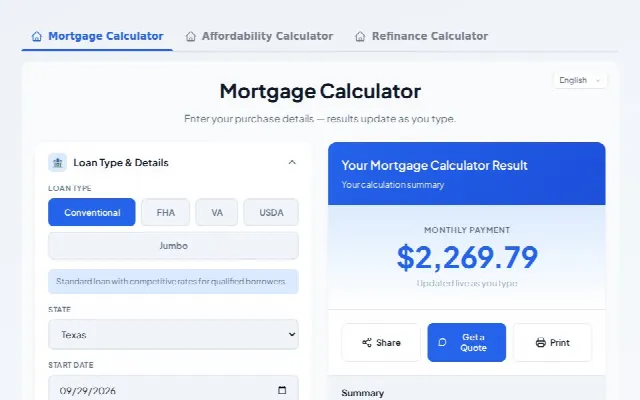
  • Tabs widget, Underline design: Text tabs with an animated underline.

    Tabs

    Calculators side by side in one block on the page, switched with tabs.

    6 ready-made designs
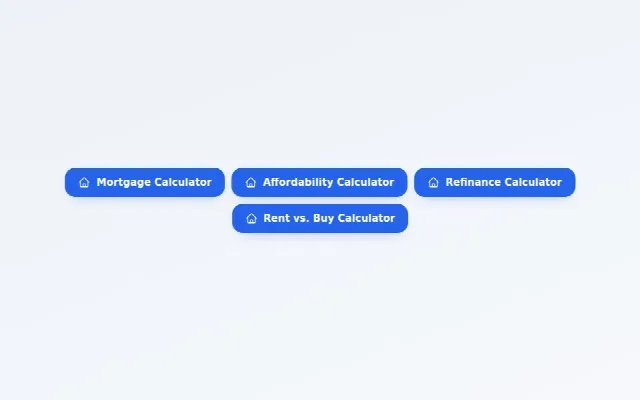
  • Buttons widget, Solid design: Filled buttons in your brand color.

    Buttons

    A row of buttons; each one opens its calculator in a popup.

    6 ready-made designs
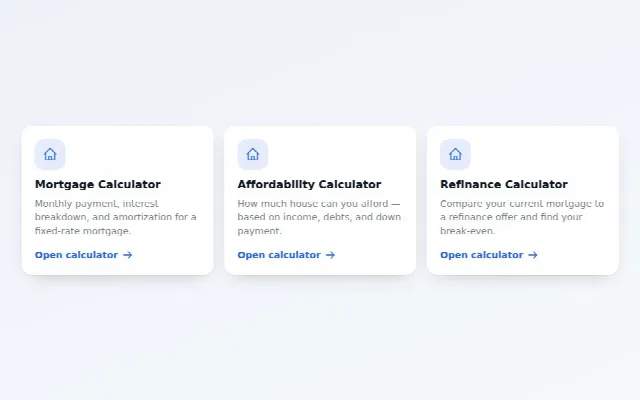
  • Cards grid widget, Elevated design: White cards with a soft shadow and lift.

    Cards grid

    A grid of cards with an icon and a short blurb; click to open the calculator.

    6 ready-made designs

See every widget design

FAQ

Financial Ratios calculator FAQs

Still stuck? Ask the team — we reply within one business day.

Q.01What does the Financial Ratios Calculator calculate?
Calculate key liquidity, leverage and profitability ratios from your balance sheet and income statement. It returns current ratio, Debt-to-Equity, net profit margin and return on equity.
Q.02What information do I need to use the Financial Ratios Calculator?
You enter 6 inputs: current assets, current liabilities, total debt, total equity, annual revenue and net income. Every input starts with a sensible default, so you can change only what you know.
Q.03What does “Current Assets” mean in the Financial Ratios Calculator?
Assets expected to convert to cash within a year.
Q.04What does “Current Liabilities” mean in the Financial Ratios Calculator?
Debts due within a year.
Q.05Is the Financial Ratios Calculator free to use?
Yes — you can use it on this page for free, without an account. Embedding it on your own website needs the Business plan (from $210/month, with a 14-day free trial), which unlocks the Business category. Compare plans.
Q.06Can I embed the Financial Ratios Calculator on my website?
Yes. Embed it inline, as a popup button, as a floating corner widget, from your own link or button, or share a direct link. It works on WordPress, Wix, Squarespace, Webflow, Shopify, GoHighLevel and plain HTML sites with one line of code — see embedding.
Q.07Can I change how the Financial Ratios Calculator looks?
Yes. Choose from 12 themes, each in light and dark, then set your own brand colors and font. Ledger, Minimal, Compact come with every plan; the others unlock on Pro and Business.
Q.08Is the Financial Ratios Calculator available in other languages?
Yes. It works in English, Spanish, Simplified Chinese, Korean, Vietnamese and Arabic, with a right-to-left layout in Arabic. Labels, tooltips, results and definitions are translated, visitors can switch language inside the calculator, and amounts stay in US dollars and US number format.
Q.09Can the calculator capture leads?
Yes. It can end with a lead form, a Get a Quote form, a Share panel or a button to any URL. Leads are saved with the inputs and results attached and can be forwarded to your CRM by webhook.
Q.10Are the Financial Ratios results financial advice?
No. Estimates only. Ratios are simplified and should be read alongside the full financial statements and industry benchmarks.

Related business calculators

All 12 in Business

Your website does the math. You get the lead.

The Financial Ratios Calculator is one of 208 calculators you can brand and embed with one line of code.

  • Free plan, no card
  • 14-day trial on Pro & Business
  • Cancel any time